I Asked Our Vet Nurse What She Actually Gives Her Own Dog. She Told Me — and I Wasn't Expecting It.
She'd been using it quietly for 18 months. She said the clinic doesn't stock it because they don't make money from it. Every dog owner needs to read this before winter hits.
I was standing in the car park of our vet clinic with a $680 treatment plan in my hand when Mel stopped me. I'd been going to that clinic for nine years. Mel is the head vet nurse there — has been for most of that time. She knows my dog by name. She knows I love him more than I'm comfortable admitting to most people.
She looked at the printout and said, "Can I tell you something I probably shouldn't tell you?" I put the paper in my bag and listened.
What she told me next changed everything. And if your dog is already struggling — especially with the cold coming — you need to read this before you do anything else.
It started with a sound I'll never forget.
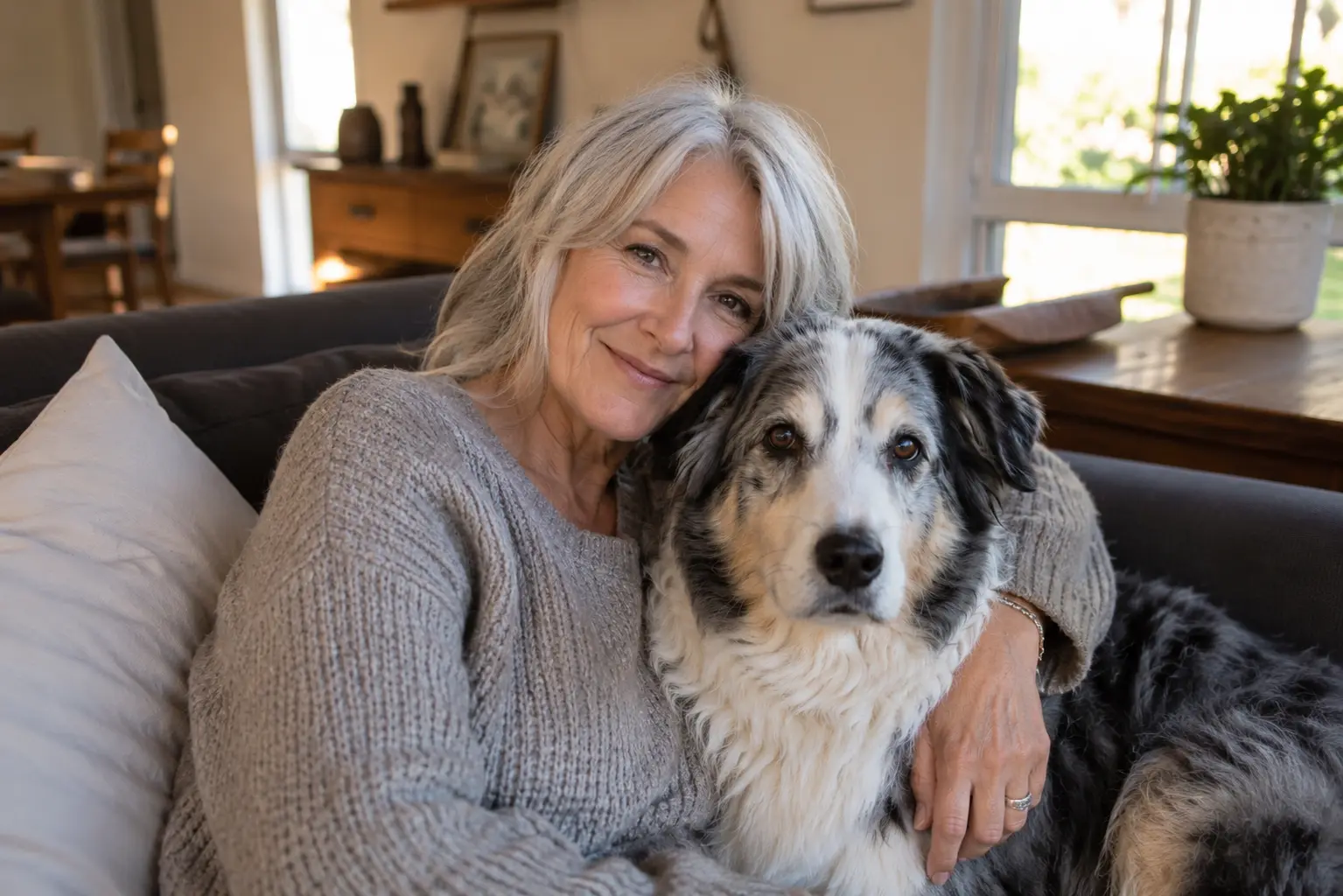
His name is Beau. He's a 12-year-old Australian Shepherd — blue merle, one blue eye, one brown eye — and he's been my shadow since I adopted him as an eight-week-old pup from a rescue in Toowoomba. He's slept at the end of my bed almost every night since. He's been there for the hard years. He was there when my marriage ended. He was there the night my mum died. He is, without question, one of the great loves of my life.
So when I came out of my bedroom one morning and heard scrambling in the hallway — that helpless sound of nails on floorboards finding no grip — and found Beau lying on his side unable to push himself up, I sat down on the floor next to him and just held him. He looked at me with those two different-coloured eyes and I thought: this might be it. This might be the beginning of the end.
I sobbed. Then I pulled myself together and booked a vet appointment.
Beau last winter. I didn't know then that we were only weeks away from getting him back.
The X-rays confirmed what I feared: osteoarthritis in both hips and wear in his left elbow. The vet was kind. She said it was "very common in medium-to-large breeds from around ten years old." She gave me a plan.
Carprofen at $62 a month. Cartrophen injections, six fortnightly sessions at $85 each. Prescription joint diet food at $115 a bag. Physiotherapy at $120 a session if I wanted to go that far. First month: over $800. Then around $300 a month ongoing. Indefinitely.
I paid the deposit on the injections and drove home. That night I started reading about the long-term risks of carprofen in older dogs: kidney stress, liver monitoring, bloodwork every twelve weeks. I lay awake thinking: there has to be something else. There has to be something that isn't doing damage somewhere I can't see.
Note for dog owners reading this in May or June: Cold weather doesn't just slow arthritic dogs down. It thickens the fluid around their joints and tightens muscles that normally support them. Vets see a significant jump in mobility-related consultations every winter. If your dog is already showing signs — hesitating on stairs, slower to rise, reluctant to walk — the cold will make it noticeably worse. The window to get ahead of it is right now.
Five months of trying things that didn't work.
Most articles skip this part. I didn't go straight to what finally worked. I spent months trying other things first and I want to be straight about that because if you're reading this, you've probably been there too.
I tried joint chews from the pet shop, the ones in the green bag. Forty dollars. Beau ate around them like they were a puzzle he'd already solved. I tried fish oil for six weeks. His coat looked better. His joints did not. I bought the memory foam orthopaedic bed from Pet Barn, $195. He loved sleeping on it. It did not fix the problem of getting off it.
The carprofen helped. Within days he was moving better. But I was reading about organ damage in older dogs at midnight and it scared me every time I put it in his bowl. I was managing the symptom and quietly destroying something else. I knew it. I just didn't know what else to do.
That's when I went back to the clinic for the first Cartrophen injection and walked out to the car park to get his lead.
Mel.
She was on her break by the side door, coffee in hand. Forties, short dark hair, the kind of vet nurse who remembers every animal she's ever treated and calls them by name years later. She waved when she saw me coming across the car park and asked how Beau was going.
I told her everything: the injections, the carprofen, the sleepless Googling. She put her coffee down on the bonnet of the car next to us.
"Can I tell you something off the record?"
"Please," I said.
"My Lab is 13. About 18 months ago she was where Beau is now, maybe a bit worse. We were having the end-of-life conversation at home." She paused. "The clinic doesn't carry what I ended up using on her. No margin in it for them. But it's the only thing that actually changed anything."
"She has access to every prescription and supplement that clinic stocks — at cost. She uses none of it on her own dog. She uses a $34.95 powder."
She told me about a vet-formulated powder she'd found online. Australian-made. Real clinical doses — not the token "dusting" amounts in most pet shop products. She'd been using it on her Lab for 18 months. Her Lab, who had been close to being put down, was still walking daily.
"I'd never mention it in there." She nodded at the clinic doors. "We sell what we sell. But you're about to spend five hundred dollars and I think you should try the thirty-five-dollar thing first."
The name she told me was Petz Park Hip + Joint.
I went back inside and rescheduled the injection for three weeks away. I drove home and spent two hours on the Petz Park website.
What I found when I looked it up.
I'm a high school librarian. I know how to spot the difference between research and marketing copy. So I went through the product properly.
What convinced me first was the label transparency. Every active ingredient listed per scoop, no vague "proprietary blend." Glucosamine 800mg. MSM 400mg. Chondroitin 400mg. Vitamin C 100mg. All there, all per scoop, nothing hidden. That's not how most supplements are labelled — and it's not an accident.
Mel had explained this to me in the car park. Most joint products contain the right ingredients but at doses too low to do anything meaningful. Petz Park uses therapeutic amounts — the quantities that actually show up in the clinical research. That's what vet-formulated means when it's real.
But what kept me reading was the reviews. Not the star rating. That's easy to fake. The actual written reviews: over 1,900 of them, with photos, from verified Australian buyers. Real dogs. Real names. Real before-and-afters written by people who sound exactly like me. I sat there for two hours reading them.
That last one. "Bought him more time." I had to put the phone down for a minute.
If you're reading this, I'm guessing you have a dog who is slowing down. You're Googling things at night. You're watching them struggle up from the floor and feeling helpless. I know exactly where you are. I was there.
Every single day you wait is a day they're waking up stiff and sore. Every cold morning between now and August is harder on their joints than the one before it. You can't get those days back.
The maths — because this part matters.
I'm practical. Before I ordered, I wrote it out.
| Treatment option | Cost |
|---|---|
| Cartrophen injections (×6 fortnightly) | $510 |
| Carprofen, ongoing monthly | $62/month |
| Bloodwork monitoring (4× per year) | $280/year |
| Prescription joint diet food | $115/bag |
| Estimated year-one total | $1,800+ |
| Petz Park Hip + Joint (90-scoop bag) | $56.95 |
I ordered one bag. It arrived in three days. Free shipping on orders over $49.
If it doesn't work, you pay nothing.
Week one.
I sprinkled the first scoop on his dinner that evening. Beef-flavoured powder, smells like it. He ate it without noticing it was there. After months of hiding chews in peanut butter, this felt almost too simple.
The first three days: nothing obvious. I was watching so carefully that I might have been imagining it either way. I told myself to give it two weeks.
Day six was when it happened. I was in the kitchen making lunch and Beau walked in (not shuffled, walked) and sat down next to the fridge the way he used to when he wanted to be near me while I cooked. He'd stopped doing that months ago because the lino was too slippery and getting up was too hard. I looked at him and couldn't move for a moment. Then I took a photo and texted my sister.
Week two and beyond.
End of week two he was waiting at the back door in the mornings. For the previous six months he'd stayed on his bed until I came to him. Now he was hearing me get up and coming to find me. That one thing — him coming to find me — undid me completely. I stood in the kitchen and cried into my coffee.
Week three he went down the back steps on his own. Four steps. I'd been lifting his back end on those steps since April. He went down, nosed around in the garden for a few minutes and came back up without any help at all. He looked up at me from the bottom step like, are you coming or not?
I called my sister from the back porch. I told her I wasn't crying. She didn't believe me.
By week six I spoke to our vet and, with her guidance, reduced the carprofen. By week eight we'd stopped it entirely. His bloodwork at the next check-up came back better than the previous one.
She watched him walk across the room at his annual check-up and asked what I'd changed.
I told her. She wrote it down.
"Whatever you're doing — keep doing it."
What happens if you wait.
I hear from a lot of dog owners now. Mostly because I've told everyone I know about this and they've told people they know. The one thing I hear over and over is: I wish I'd found this sooner.
Not from people who tried it and it didn't work. From people who waited — who kept watching their dog slow down, telling themselves it was just age, that it would plateau, that they'd try something next month — and then hit a winter where things got significantly worse. A dog who was stiff becomes a dog who can't get up. A dog who was reluctant on the stairs becomes a dog who won't go near them. That progression is real and cold weather accelerates it.
Every day you wait, your dog is:
- Waking up stiff and sore — every single morning
- Spending another cold night with inflamed joints that can't recover overnight
- Losing muscle mass they won't fully get back
- Missing walks, play and the moments that make their life worth living
- Drifting further from the dog you know — because pain changes them
The cold is already here. It gets worse from here through August. The dogs who do best are the ones whose owners act now — before the worst of winter — not after.
Think about what Mel told me. She works inside a vet clinic. She has access to every prescription treatment, every supplement, every pharmaceutical they stock — at cost. She doesn't use any of it on her own dog. She uses a vet-formulated powder that costs $34.95.
She had no reason to tell me that. But she did. And that told me everything.
Six months on.
Beau is almost 13 now. He still naps in the afternoon sun and he doesn't chase possums anymore. Some things are just age and I've made peace with that.
But he meets me at the door every morning. He walks with me to the end of the street. He sleeps next to my bed and gets up when I do, on his own, without me helping him. Last week he got onto the couch — the one he hadn't been able to manage for eight months. I let him stay there all afternoon.
I cancelled the injection course entirely. That deposit is long gone and I don't care.
The only regret I have is the months I spent on things that didn't work, watching him hurt, when this was out there the whole time. If you're reading this and your dog is already struggling, please don't make the same mistake I made. Don't wait. Don't watch another winter go by.
We're heading into winter right now. This is exactly when arthritis and joint pain get worse in dogs — colder temperatures, less movement, stiffer mornings. Demand for Hip + Joint spikes every June and Petz Park regularly sells out. Last year there was an 11-day stockout. If you order today, you're locking in your supply before that happens — and starting your dog on the supplement before the worst of the cold arrives. Every week you start earlier is a week ahead of the pain.
Free shipping on orders over $49 · Results typically seen within 2–4 weeks
© 2026 Pawprint Australia. All rights reserved.
Health Disclaimer: Hip + Joint is a dietary supplement and is not a substitute for professional veterinary care. Always consult your veterinarian before starting any new supplement, especially if your pet has an existing condition or is taking medication. Individual results may vary.