
She survived Stage IV non-Hodgkin's lymphoma in medical school.
In February 2021, she received a heart transplant at Mayo Clinic.
One year and one day later, she became the first person on record to complete a full marathon within one year of a heart transplant.6
And after twenty years as a Mayo Clinic oncologist, Dr. Dawn Mussallem is now telling her own patients to throw out most of the supplements in their bathroom cabinet.
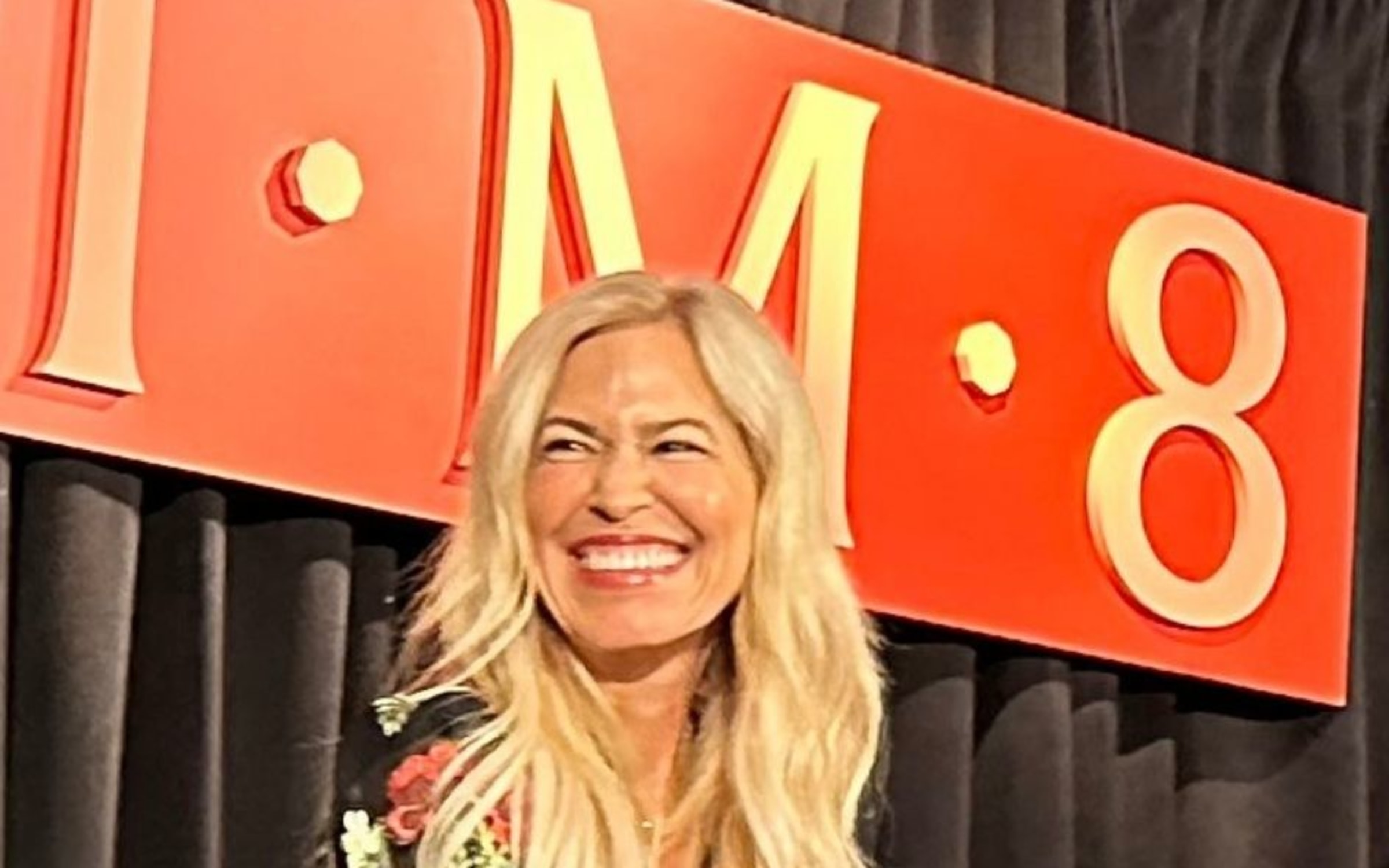
Dr. Dawn Mussallem, Mayo Clinic oncologist and Founding Scientific Advisor to IM8.
The Patient Who Changed Her Mind
The conversation that started all of this happened in her Jacksonville office about two years ago.
A 62-year-old woman walked in carrying a printed list. Twelve different supplements. Multivitamin. D3. K2. B-complex. CoQ10. Magnesium. Omega-3. Probiotic. Greens powder. Glucosamine. Ashwagandha. Digestive enzymes.
Total spend: about $311 a month. Roughly $3,700 a year.
The woman was still tired by 3 p.m.
Still foggy in the morning.
Still waking up unrefreshed at 5:30 a.m. and giving up on going back to sleep.
And when Dr. Mussallem ran her bloodwork, three nutrients came back deficient — despite the cabinet.
That patient is not unique. According to one verified Trustpilot reviewer who switched to a different protocol after years of the same routine:
"I turned 60 last year, I had joint aches, felt sluggish and had some brain fog. I couldn't keep a consistent supplement routine, too many to swallow."
— Verified Trustpilot review, 5 stars
Dr. Mussallem says she has had a version of this same conversation hundreds of times.

The average American over 50 takes 4–6 supplements daily — and absorbs almost none of them properly.
What the Federal Government Quietly Said in 2022
Most Americans over 50 don't realize this — but the U.S. government has effectively told them to stop.
In 2022, the U.S. Preventive Services Task Force, the same federal panel that sets the national standard for mammograms and colonoscopies, published a recommendation in the Journal of the American Medical Association (JAMA).
The conclusion, in their own words:
For multivitamins specifically, they said the evidence is "insufficient" — meaning the panel couldn't find proof they reduce heart disease, cancer, or all-cause mortality.1
That wasn't a fringe opinion.
In 2024, JAMA Network Open published a study tracking 390,124 adults for over 20 years. The conclusion: daily multivitamin use was not associated with lower mortality. None.2
Eleven years earlier, an editorial in the Annals of Internal Medicine — the journal of the American College of Physicians — put it bluntly:
This is not Dr. Mussallem's opinion. It is the consensus of the institutions that train her.

Three federal-grade studies in the last decade have all reached the same conclusion.
So Why Are 77% of Americans Over 50 Still Doing It?
Because — and this is where Dr. Mussallem's view differs from the loudest critics — nutrition matters. The science is clear that micronutrient deficiencies in adults over 50 are a real and underdiagnosed problem.
The issue isn't the idea of supplementing.
The issue is the delivery system.
Walk down the supplement aisle of any Walgreens and you will see the same three structural problems repeated on every label:
1. Sub-clinical doses. The amount of CoQ10 in a typical multivitamin is around 30 mg. The amount studied for cardiovascular and energy benefit is closer to 100–200 mg. The 30 mg is, in industry slang, "fairy dusting" — just enough to put on the label.
2. The wrong form. Up to 70% of adults carry an MTHFR genetic variant that limits their ability to convert synthetic folic acid into the active 5-MTHF form the body actually uses. Most multivitamins still use the cheap synthetic. Same story for B12 (cyanocobalamin vs methylcobalamin), magnesium (oxide vs glycinate), and Vitamin D3 (irradiated lanolin vs lichen-derived).
3. Nutrient interference. This is the one almost nobody talks about.
Take calcium and iron together — common in most "50+" multivitamins — and calcium can blunt iron absorption by up to roughly 50% when both are taken at supplemental doses. Add a morning coffee (whose polyphenols can knock iron absorption down even further) and the iron line on your label is mostly theater.4
Take 50 mg of zinc for "immune support" and you can block copper absorption by up to 50% within the same dose. Within four to six weeks, your zinc habit can quietly leave you copper-depleted.5
Vitamin C at high doses interferes with B12. Magnesium oxide is poorly absorbed (about 4%) compared to magnesium glycinate. Cyanocobalamin B12 is significantly less bioavailable for the millions of adults with MTHFR variants.
The math is brutal: most of the $311 a month is going down the toilet. Literally.
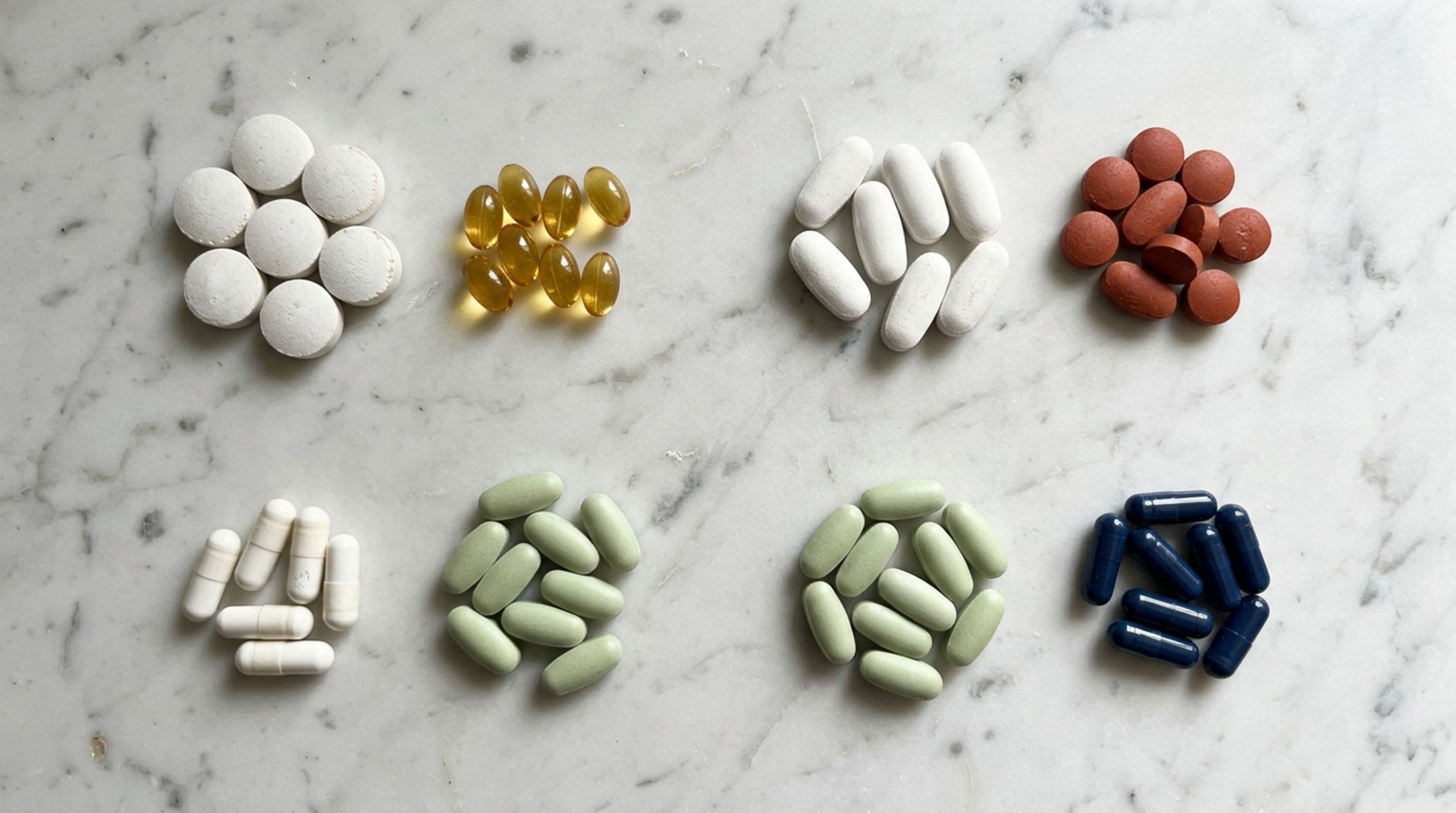
Calcium blocks iron. Zinc blocks copper. Vitamin C interferes with B12. Most stacks are at war with themselves.
The Turning Point
Dr. Mussallem first started thinking seriously about a single-scoop replacement after her own heart transplant in February 2021.
She was twenty-six years old — about three months into medical school — when she was diagnosed with Stage IV diffuse large B-cell non-Hodgkin's lymphoma. A 16-centimeter tumor was wrapped around her heart. She presented to the ER in cardiogenic shock.
The chemotherapy she received saved her life — and slowly destroyed her heart muscle. Two decades later, she needed a transplant. On February 5, 2021, surgeons at Mayo Clinic gave her a new one. She walked out of the hospital, unassisted, two weeks later.
One year and one day after surgery, she ran the Donna Marathon in Jacksonville. As of this writing she remains the first person on record to complete a full marathon within one year of a heart transplant.6
After all of that, every milligram of nutrition she put into her body had to actually count.
She tried the cabinet. The pillbox. The blister-packed "personalized stack" services. She still couldn't trust what was being absorbed.
In 2024, the team behind a London-listed health-tech company — Prenetics, the same one David Beckham co-founded a supplement brand with — approached her about joining their Scientific Advisory Board.
She did what any practicing oncologist would do: she vetted the science before she said yes. She read the trial protocol. She read the ingredient panel line by line. She read the names of the other advisors:
- Dr. James L. Green — former Chief Scientist, NASA, 42 years
- Dr. David Katz — Founding Director, Yale-Griffin Prevention Research Center
- Prof. Stephen Anton — Department of Aging Research, University of Florida
- Prof. Suzanne Devkota — Microbiome researcher, Cedars-Sinai
Then she signed.
She is now a Founding Scientific Advisor to IM8 Health.

Dr. Mussallem on the trail — one year and one day after her heart transplant, she completed her first marathon.
What's Actually In the Scoop
The product Dr. Mussallem signed her name to is called IM8 Daily Ultimate Essentials. It is a single-scoop powder taken once a day in water.
The core spec sheet, verbatim from the published ingredient panel:
- 90 nutrient-rich ingredients in a single daily drink
- Built around IM8's patent-pending CRT8™ Cell Rejuvenation Complex
- Plus 7+ clinically-validated branded ingredient forms — Quatrefolic® (active 5-MTHF folate), AstaPure® astaxanthin, DE111® and BC99® probiotics, VEGD3® lichen-derived Vitamin D3, FloraSMART® postbiotic, Nutralga® algae mineral complex
- NSF Certified for Sport — tested against 280+ banned substances, heavy metals, and contaminants
- 12-week randomized controlled trial conducted by the San Francisco Research Institute on the finished formula
That last point matters. Most supplements you can buy have no clinical trial on the actual finished product. They cite trials on individual ingredients in isolation. The IM8 formula was tested as it ships, in adults, for three months.8
The published outcomes:
- 95% of participants reported a noticeable boost in daily energy
- 80% of participants reported getting better sleep
- 85% felt less bloated and reported improved digestion
- 75% of participants noticed sharper focus and improved mental clarity

One scoop. Once a day. 90 ingredients in clinically-validated forms.
And One Receipt That Almost No Other Supplement Brand Has
This is the part that surprised even Dr. Mussallem.
IM8 Daily Ultimate Essentials is now stocked on store.mayoclinic.com — the retail outlet of the #1-ranked U.S. hospital per U.S. News & World Report.
Three distinct SKUs are live as of this writing — the Jar, the Travel Sachets, and the Gusset Bag — all priced at $112, all flagged HSA/FSA eligible.7
The Mayo Clinic Store is not a medical endorsement. It is a retail listing. But Mayo Clinic is famously conservative about which supplement brands they will stock under their own banner. The number of greens-powder brands that have reached this shelf is extremely short.
For most consumers, this is the first time they've ever seen the words "Mayo Clinic" and "supplement" appear on the same product page.
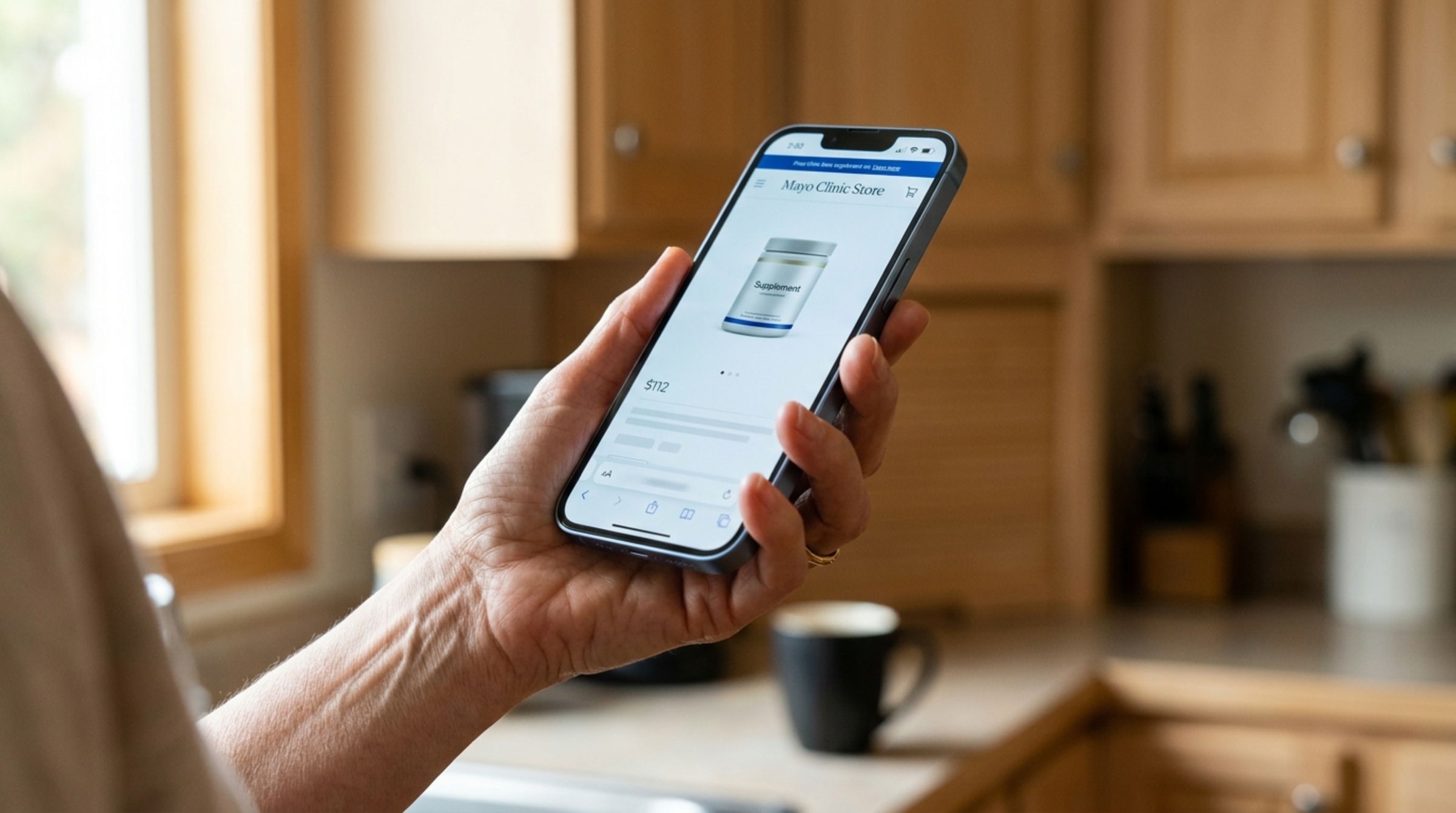
Three IM8 SKUs are now stocked on the Mayo Clinic Store, all HSA/FSA eligible.
How It Compares to AG1
The honest comparison most people are looking for:
| Spec | IM8 Daily Ultimate Essentials | AG1 |
|---|---|---|
| Subscription price (30-day) | $89 | $79 |
| Cost per serving (best plan) | $2.61 (90-day) | $2.63 |
| Total ingredients | 90 | 75–83 |
| Vitamin D3 | 1,200 IU included | Sold separately |
| MSM (joint support) | 1,000 mg | None |
| CoQ10 | 100 mg | 60 mg |
| Vitamin C | 900 mg | 500 mg |
| Postbiotic | FloraSMART® included | None |
| Mayo Clinic Store listing | Yes, 3 SKUs | No |
| Beckham co-founder + Mayo / NASA / Yale advisory board | Yes | No |
| NSF Certified for Sport | Yes | Yes |
| 90-day money-back guarantee (quarterly) | Yes | Yes |
AG1 is a serious product with a serious history. It is also, for most people over 50, the wrong product.
What you're paying for at IM8 — even at a slightly higher monthly tag — are the things AG1 deliberately doesn't include: the joint support, the included D3, the postbiotic, the higher CoQ10 and Vitamin C dose, and the institutional credibility of a Mayo Clinic Store listing and a named-physician advisory board.
The Math Most People Don't Run
This is the part Dr. Mussallem says she walks her own patients through, slowly, with a calculator.
| Item | Conventional Stack | IM8 Daily Ultimate Essentials |
|---|---|---|
| Multivitamin | $20 | included |
| Vitamin D3 + K2 | $33 | included |
| B-complex (methylated) | $25 | included |
| CoQ10 (ubiquinol) | $30 | included |
| Magnesium glycinate | $18 | included |
| Omega-3 fish oil | $40 | included |
| Probiotic | $35 | included |
| Greens powder | $35 | included |
| Joint support (MSM) | $25 | included |
| Adaptogen (ashwagandha) | $15 | included |
| Postbiotic / digestive enzymes | $35 | included |
| Monthly total | ~$311 | $89 |
Switch the stack for one scoop and you save approximately $222 a month. Over a year, that's $2,664.
You also stop fighting the calcium-iron, zinc-copper, and Vitamin-C-B12 absorption wars happening inside your own gut every morning.
And — this is the part most accountants miss — IM8 is HSA/FSA eligible with a 98% approval rate, meaning for many adults the actual out-of-pocket cost drops further still.
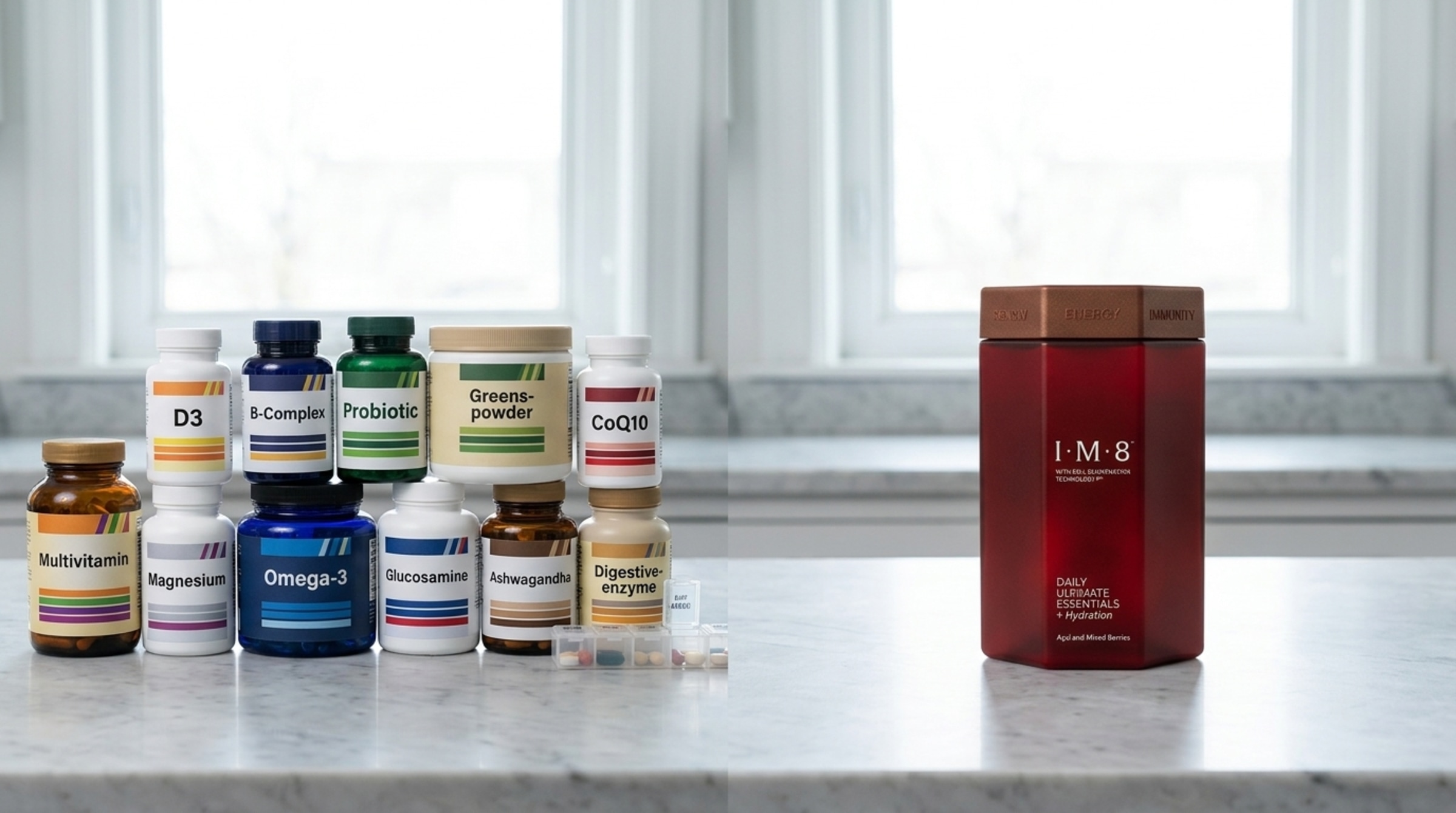
$311 a month, twelve bottles, four absorption conflicts — replaced by one scoop.
What People Actually Report After 90 Days
The 12-week clinical trial outcomes are one thing. The real-world response is another.
The product has:
- 4.8 stars on Trustpilot across 16,255 verified reviews
- 700,000+ customer purchases
- 20 million+ servings consumed
- Shipping to 65+ countries
The patterns Dr. Mussallem says she sees most often in her own patients who switch:
- The 3 p.m. energy slump softens within the first 2–3 weeks — usually the first thing patients notice
- Morning brain fog tends to lift around week 4–6
- Joint stiffness and digestive complaints take longer — typically 8–12 weeks before patients describe them as "different"
- Sleep tends to be the last thing to shift, but it shifts
Individual results vary. This is a supplement, not a medication. But after twenty years of writing prescriptions, Dr. Mussallem says it is rare to see a single intervention move four separate complaints in the same direction at once.
How To Try It
For readers who have made it this far, here is the plain-English breakdown:
- One-time, 30-day jar: $112 ($3.73/serving). Good for trying.
- Monthly subscription: $89 every 4 weeks ($2.97/serving). Save 20%. 30-day money-back guarantee.
- Quarterly subscription: $235 every 12 weeks ($2.61/serving). Save 30%. 90-Day Money Back, No Questions Asked.
The quarterly plan is the one most readers over 50 are choosing — both because it's the lowest cost-per-serving and because the 90-day guarantee gives you a full clinical-trial-length runway to actually feel the difference before committing.
If after 90 days you don't feel the change Dr. Mussallem and 95% of trial participants describe, you ship the bag back and they refund you. No questions. No phone-tree.
Free shipping in the US, Canada, UK, and EU. HSA/FSA eligible at checkout (98% approval rate).
The product currently ships from existing stock, but Mayo Clinic Store SKUs have been moving fast since the listing went live earlier this year — quarterly subscribers are prioritized for inventory allocation if a holdup ever does occur.
Try IM8 Daily Ultimate Essentials — 90-Day Money BackFree shipping. HSA/FSA eligible at checkout.

One scoop a day. 90-day guarantee. The math finally makes sense.
A Final Note from Dr. Mussallem
In her own words, from her IM8 profile page:
"My personal journey — from battling Stage IV cancer to undergoing a heart transplant — taught me the importance of resilience and integrative health. I joined IM8 to inspire others and contribute to life-changing products that support the body's ability to heal and thrive."
— Dr. Dawn Mussallem, Founding Scientific Advisor, IM8 Health
For most readers over 50, the question is no longer whether to supplement.
It is whether to keep paying $311 a month for a stack the federal government has effectively recommended against — or to replace it with one scoop, designed by the kind of physician who has personally needed it to work.
Get Started — Quarterly Plan, 90-Day Guarantee$2.61/serving. Free shipping. HSA/FSA eligible.
Sources & Legal Notices
Disclaimer
This article contains advertising content. Dr. Dawn Mussallem is a Founding Scientific Advisor to IM8 Health and has a financial relationship with the brand. Individual testimonials reflect individual experiences and are not representative; individual results may vary. This article is for informational purposes only and does not replace medical advice. Consult your physician about pre-existing health conditions before starting any supplement. Dietary supplements are not a substitute for medical treatment and are not intended to diagnose, treat, cure, or prevent any disease. The studies cited refer to the product category and, where noted, to the specific IM8 formula 12-week randomized controlled trial. The Mayo Clinic Store is a retail outlet; product listing does not constitute medical endorsement by Mayo Clinic.
Sources
- U.S. Preventive Services Task Force. Vitamin, Mineral, and Multivitamin Supplementation to Prevent Cardiovascular Disease and Cancer: USPSTF Recommendation Statement. JAMA. 2022;327(23):2326-2333.
- Loftfield E et al. Multivitamin Use and Mortality Risk in 3 Prospective US Cohorts. JAMA Network Open. 2024.
- Guallar E, Stranges S, Mulrow C, Appel LJ, Miller ER 3rd. "Enough Is Enough: Stop Wasting Money on Vitamin and Mineral Supplements." Annals of Internal Medicine. 2013;159(12):850-851.
- Calcium-iron absorption interaction meta-analysis, Journal of Nutrition (2022); single-meal interaction studies, PubMed PMID 21462112.
- Zinc-copper transporter competition; high-dose zinc effect on copper absorption — PubMed PMID 18820153.
- Mayo Clinic News Network: "Running to a New Beat — Heart Transplant Recipient to Mark 1-Year Anniversary with Marathon." Mayo Clinic Cancer Blog, February 23, 2022.
- Mayo Clinic Store IM8 brand page — store.mayoclinic.com/im8 — verified live, 3 SKUs, HSA/FSA eligible.
- San Francisco Research Institute — A 12-week Randomized, Controlled, Clinical Trial Evaluating the Efficacy of a Dietary Supplement Powder Formula (Daily Ultimate Essentials) in an Adult Population. Trial details: im8health.com/pages/science.