Every Morning, Millions of Americans Do Something That Doesn't Work
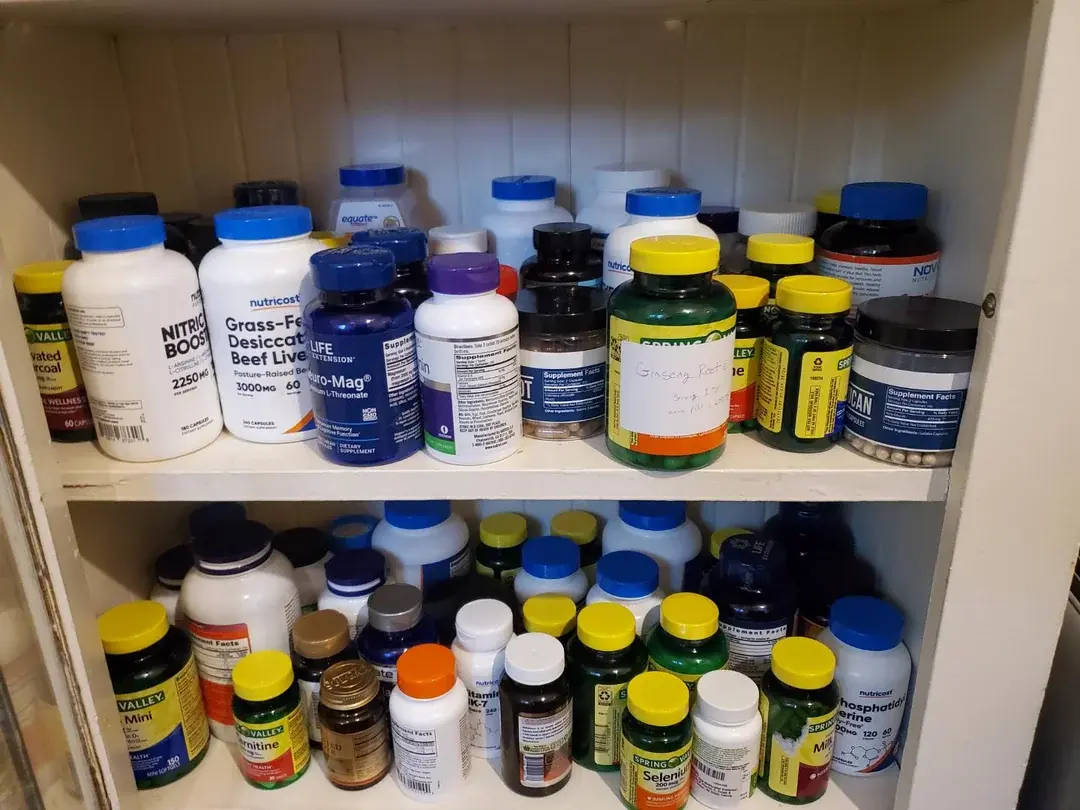
Picture a kitchen counter in suburban America. It's 7am. A 52-year-old woman we'll call Linda lines up her morning routine: a multivitamin, fish oil, Vitamin D, magnesium, a probiotic, B12, CoQ10, a greens powder, and an ashwagandha capsule she read about in a magazine. She swallows them all. She does this every single morning without fail.
She's been doing it for six years. She spends about $280 a month. And she still wakes up tired, still struggles through 3pm, still can't quite shake the brain fog that crept in sometime around her late forties.
Linda isn't unusual. Linda is America.
According to the Council for Responsible Nutrition, three quarters of American adults take dietary supplements regularly. Among adults over 45, that number climbs to nearly 80%. The average supplement user over 45 spends between $2,400 and $4,800 per year. And yet, as a landmark study published in the Annals of Internal Medicine concluded, most of them are receiving no measurable health benefit from the majority of what they're taking.
This is not an article about why you should stop caring about your health. Quite the opposite. This is an investigation into why the system most Americans over 45 are using to support their health is fundamentally broken — and what the science says about doing it better.
The $35 Billion Industry That Profits From Your Confusion

The dietary supplement industry in America generated over $35 billion in revenue last year. It is one of the fastest growing sectors in consumer health, with projections putting it at $60 billion by the end of the decade. And it is almost entirely unregulated in the way most Americans assume it is.
Unlike prescription drugs, supplements do not require FDA approval before they go to market. Manufacturers are not required to prove their products are effective. They are not required to use clinically validated doses. They are required only to ensure their products are not unsafe — a bar so low it effectively permits almost anything.
"The supplement industry's business model is not built around solving your health problems. It is built around selling you the next product. Confusion is a feature, not a bug."
The result is a marketplace flooded with products that look scientific, use impressive terminology, and carry price tags that suggest premium quality — but deliver a fraction of what they promise. A 2020 analysis published in JAMA Network Open found that nearly 60% of top-selling supplements contained less of the active ingredient than their labels claimed. Some contained none at all.
More troubling is what happens when you look at dosing. The average multivitamin sold in America contains nutrients at doses so low they are clinically meaningless. A typical Vitamin D3 supplement contains 400 IU — the Endocrine Society recommends 1,500 to 2,000 IU daily for adults over 50 to maintain optimal serum levels. A standard magnesium supplement delivers 100mg — studies show most adults over 45 need 300 to 400mg daily, and most are severely deficient.
This isn't accidental. Supplements are priced per unit, not per effective dose. Using a smaller amount of an active ingredient costs less and improves margins. The consumer sees the ingredient on the label and assumes it's working. The manufacturer knows better.
What Changes After 45 That Nobody Tells You About

To understand why so many Americans over 45 feel the way they do — tired, foggy, stiff, slow — you first need to understand what happens to the body after the mid-forties in biological terms. Because most of the symptoms people chalk up to "just getting older" are actually the result of specific, documented, and addressable physiological changes.
Nutrient Absorption Declines Significantly

After 45, the stomach produces less hydrochloric acid. This matters because stomach acid is essential for breaking down and absorbing key nutrients — particularly B12, iron, calcium, and magnesium. A study in the American Journal of Clinical Nutrition found that adults over 50 absorb up to 30% less of certain nutrients from the same food and supplement sources as younger adults.
This means that even if you are taking the right supplements at the right doses, your body may be absorbing a fraction of what you're giving it. The form of the nutrient matters enormously here. The cheapest and most common form of B12 — cyanocobalamin — is significantly less bioavailable than methylcobalamin, the form your cells can actually use. Most supplements use the cheap version.
Mitochondrial Function Declines
Your mitochondria are the energy-producing engines of your cells. After 45, mitochondrial density and efficiency decline measurably. This is the primary biological reason for the fatigue, reduced stamina, and slow recovery that so many adults experience in their late forties and beyond. CoQ10 — a nutrient critical for mitochondrial function — declines naturally with age and is further depleted by common medications including statins.
The Inflammatory Burden Increases
Chronic low-grade inflammation — what researchers have begun calling "inflammaging" — increases steadily after middle age. It manifests as joint stiffness in the morning, slower recovery from exercise, increased gut sensitivity, and a general feeling of physical heaviness. Left unaddressed, it is a driver of virtually every major age-related disease.
If any of these sound familiar, you are not alone:
These are not inevitable symptoms of aging. They are symptoms of specific nutritional and physiological gaps — most of which are addressable. The problem is that the supplement industry's approach to addressing them is fragmented, under-dosed, and inefficient.
The Synergy Problem: Why Taking 10 Supplements Is Often Worse Than Taking None
Here is something the supplement industry will never tell you: nutrients don't work in isolation. The way they interact with each other — their synergies and antagonisms — is as important as the doses you take. And when you assemble a supplement routine from ten different products made by ten different manufacturers with ten different formulations, you have no control over any of that.
Consider some well-established nutritional interactions:
Vitamin D3 requires Vitamin K2 to direct calcium to bones rather than arteries. Taking D3 without K2 at the right ratio can actually increase arterial calcification risk over time.
Magnesium is required for Vitamin D activation. Without adequate magnesium, supplemental Vitamin D cannot be converted into its active form. Most Americans are magnesium deficient. Most Vitamin D supplements contain no magnesium.
B vitamins work as a complex, not individually. Taking high-dose B12 alone without the full B-complex can create imbalances. The same is true for folate and B6.
Zinc and copper compete for absorption. Supplementing zinc without copper can deplete copper levels over time, contributing to fatigue and neurological symptoms.
A well-constructed supplement regimen accounts for all of these interactions. A randomly assembled collection of products from different brands does not. And the research bears this out — a 2019 systematic review published in the British Medical Journal found that multivitamins designed around nutrient synergy significantly outperformed equivalent single-nutrient supplementation across measures of energy, cognitive function, and inflammatory markers in adults over 50.
Bioavailability: The Form Matters More Than the Dose
The most important question when evaluating any supplement is not how much of an ingredient it contains, but how much of that ingredient your body can actually absorb and use. This is bioavailability — and it varies enormously between different forms of the same nutrient.
Magnesium oxide — the form found in most cheap supplements — has a bioavailability of around 4%. Magnesium glycinate, by comparison, is absorbed at rates of 80% or higher. Yet magnesium oxide costs a fraction as much to produce. Guess which form most supplement manufacturers use.
The same principle applies across virtually every nutrient category. Synthetic Vitamin E (dl-alpha-tocopherol) is roughly half as potent as natural Vitamin E (d-alpha-tocopherol). Folic acid requires a conversion step that a significant percentage of the population — those with MTHFR gene variants — cannot perform efficiently, making methylfolate the only effective form for those individuals. Cyanocobalamin vs methylcobalamin for B12. Calcium carbonate vs calcium citrate. The list goes on.
The cheapest form of a supplement and the most effective form of a supplement are almost never the same thing. And because labelling requirements do not require manufacturers to specify the form used, most consumers have no way of knowing what they are actually buying.
After Three Months of Research, Here Is What We Decided Actually Matters

We spent three months reviewing the scientific literature on supplementation in adults over 45, speaking with nutritionists and integrative medicine specialists, and evaluating the market landscape to understand what an evidence-based approach to daily supplementation actually looks like.
What we found is that there are really only seven criteria that matter. If a supplement — or a supplement regimen — meets all seven, it is worth taking seriously. If it falls short on any of them, it is almost certainly underdelivering.
- 1Clinically Dosed — Not Label DressingEvery ingredient must be present at the dose used in peer-reviewed clinical research. Anything less is cosmetic — designed to impress on a label, not to work in your body.
- 2Bioavailable Forms — Not Cheap Synthetic VersionsMethylcobalamin not cyanocobalamin. Magnesium glycinate not magnesium oxide. Methylfolate not folic acid. The form determines whether your body can actually use it.
- 3Multi-System Coverage — Address the Whole BodyAfter 45 your body needs support across multiple systems simultaneously — energy, brain, gut, immune, joints, heart, sleep. Point solutions for one system while ignoring others don't move the needle on how you feel overall.
- 4Formulated for Synergy — Not Just CompletenessIngredients must be selected and dosed to work together, not simply assembled for label impressiveness. D3 with K2. Magnesium to activate D3. The full B-complex. Zinc with copper balance.
- 5Independently Third-Party TestedGiven that 60% of supplements contain less than claimed, independent verification of purity and potency is non-negotiable. NSF Certification or equivalent is the minimum acceptable standard.
- 6Developed With Credible Scientific OversightNot celebrity-endorsed. Not marketing-team formulated. Developed with active input from researchers with relevant clinical credentials and published track records.
- 7Backed by a Meaningful GuaranteeAny company genuinely confident in their product's efficacy should be willing to offer a substantial money-back period. 90 days is the benchmark — long enough to actually assess whether something is working.
With these seven criteria established, we evaluated over 40 products currently available on the American market. The results were, frankly, discouraging. The vast majority of products — including several with significant marketing budgets and strong brand recognition — failed on at least three of the seven criteria.
The most common failures were bioavailability (cheap synthetic nutrient forms used to cut costs), dosing (clinically insignificant amounts of key ingredients), and scientific oversight (marketing-led formulation rather than research-led). A handful of products met four or five criteria adequately. Only one met all seven — and it wasn't even close.